Ensuring Georgetown’s Future and the Regulation of its Development
Part I – What is a Comprehensive Plan and why is it so important?
Comprehensive plans play a pivotal role in guiding the future of cities throughout the country. They act as a roadmap guiding us toward sustainable, resilient and vibrant communities. You can’t build a house without blueprints. Likewise, you can’t grow a community without a vision, one that is captured in the Comprehensive Plan.
A Comprehensive Plan is comparable to a strategic plan; in fact, back in 2003 Georgetown city actually authored its first Strategic Plan. A Comprehensive Plan sets forth a vision and goals for a city's future, and provides the overall foundation for all land use regulation in the city. State law mandates all cities to prepare and implement a comprehensive municipal plan.
The parts of the Comprehensive Plan are called “elements”. The law leaves local governments to pursue the ten comprehensive plan elements in a way that best meets their communities’ needs. However, for each element, the law specifies that the planning process should include an inventory of existing conditions, a statement of the local government’s needs and goals and implementation strategies with timeframes.
The Ten Elements are:
-
The plan should consider the historic population trends, anticipated growth as well as demographic specifics, like the size and number of households, education levels and income.
-
This should address the characteristics of the available workforce, where workers live and other aspects of the local economy. Useful considerations can be manufacturing, tourism or revitalization.
-
What kind of water bodies, parks and recreation areas, agricultural land, forest land and wildlife habitats, does the area have? This element also needs information on the area’s flood plains.
-
These can be historic buildings and sites; unique commercial, residential or natural areas; and educational, religious or entertainment institutions.
-
Community facilities include many assets necessary for development. This can include water, sewer and wastewater services; solid waste disposal; fire protection; as well as medical, governmental and educational facilities. The local government must adopt this element before adopting any subdivision or other land development regulations.
-
What are the locations, types, ages and conditions of existing housing? How many are owner-occupied or renter-occupied? What is the cost of developing a sufficient amount of affordable housing, and what regulations may prevent that?
-
This element should consider the municipality’s current and future land uses in categories such as residential, commercial, industrial, agricultural, undeveloped and others. The local government must adopt this element before adopting zoning ordinances.
-
This element considers road improvements, new road construction as well as pedestrian and bicycle projects. The transportation element should coordinate with the land use element to provide planning for sufficient transportation options for the current and future land uses.
-
This is an analysis of projected federal, state and local funds for infrastructure and facilities in the next decade, and recommended projects for those funds.
-
This element, added in 2020, considers the impacts of flooding, high water, and natural hazards on individuals, communities, institutions, businesses, economic development, public infrastructure and facilities, and public health, safety and welfare.
-
There are several optional elements, which are likely to be applicable for Georgetown. These include Energy, Urban Design, Social Infrastructure, Tourism and Coastal Zone.
the elephant in the room
So, if a Comprehensive Plan is so meaningful, why is the City’s Planning department apparently down playing its importance and implying that it some form of obligatory formality?
As an example, in a recent social media post, the city attempts to summarize the Comprehensive Plan. In the slide’s narrative there seems an under-current to diminish its importance as though it is a non-essential work-product. Furthermore, it states that the comprehensive plan is not regulatory; in fact, this is stated twice as though to infer or emphasize that the Comprehensive Plan is not essential somehow. This is factually incorrect; while technically not statutory, a bill was passed for it to enter the SC Code of Laws in 1994 as the South Carolina's Comprehensive Planning Enabling Act, found in SC Code Title 6, Chapter 29. It provides cities and towns with authority to undertake planning and adopt zoning and land use regulations as tools to use in their communities' development. It sanctions and strongly encourages municipalities to establish a Planning Commission, develop a Comprehensive Plan and maintain a Capital Improvement Plan.
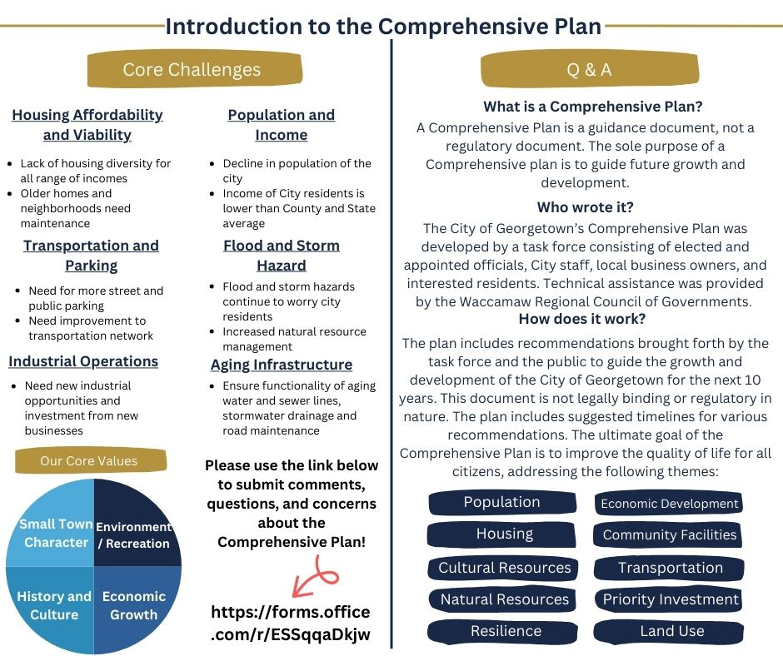
A well-grounded Comprehensive Plan should be based on the City’s core values, vision, and principles. Collectively they form the bedrock that should permutate thru all aspects of the document.
The core values as stated are;
· Small Town Character
· Environment / Recreation
· History and Culture
· Economic Growth
These are generic statements of fact, not core values. A core value is a belief system based on principle; something that we hold close to our hearts and embodies our collective vision for the city. So, my question to the city is have these been defined and vetted in a public forum?
The next mis-statement that caught my eye was the Comprehensive Plan’s purpose; more specifically that the “sole” purpose of the Comprehensive Plan was to “guide” future growth and development. A Comprehensive Plan does not have a singular purpose and is much more than a guide. It defines strategies, goals and priorities & timelines for improvement projects that should span out on a ten-year (or more in some cases) time horizon. By definition it is a Comprehensive Plan, so it should be the definitive roadmap to plan for the future. Its absence leads to rudder-less short termism rather than long term investment, strategic planning and projects.
Most, if not all, Cities consider the Comprehensive Plan as so vital for their future that they devote significant resources, including Website content, to communicate all aspects of the planning process and accountabilities. A local example is Moncks Corner. https://monckscornersc.gov/government/community-development/comprehensive-planning. In contrast, Georgetown’s site barely makes any reference to the Comprehensive Plan and it is not even described in the responsibilities of the Planning Commission. https://www.georgetownsc.gov/governmental_services/boards___commissions/planning_commission.php
The existence of a comprehensive plan has far-reaching implications, including the investment community. Having a true “comprehensive” plan garners investor confidence that the city is being governed prudently that will lead to a viable and sustainable future. This is not just private investment; institutional investors monitor the plans of each municipality to decide whether the investment risk meets the bond’s goals. I can assume that the rate of development of Mount Pleasant, that Paige Sawyer highlighted in his post, was partially built on municipal bonds. Their local government could not have invested in infrastructure, like broadening Hwy 17 into a 8-lane thoroughfare, without institutional investment.
To greater appreciate the importance of municipal funding and the impact of bond ratings, you have to look no further than Beaufort SC; https://www.cityofbeaufort.org/FAQ.aspx?QID=208
At this juncture of the city’s history, I cannot help but reflect another pivotal point in its past. During Mayor Morgan’s tenure (1891-1906) the face of Georgetown changed dramatically. Physical changes included the new schools, a new federal office building, oak and elm trees lined Georgetown’s streets, concrete sidewalks in much of the business area, electric street lights, and new streets in the West End. Morgan was active in securing appropriations for deepening Georgetown Harbor, and encouraged lumber businesses to move to the area. This did not happen coincidentally; clearly Mayor Morgan and his lieutenants on the council knew how to tap into the values and needs of the city and developed strategies and implementation plans. It needed strong commitment and resolve. Although his actions predate today’s formal planning processes, there must have been strong leadership, a clear vision and direction to implement these key aspects of our city.
So, in summary, a Comprehensive Plan needs to be visionary, definitive and actionable reflecting the city’s vision, core values and principles. Failing that, all effort and time developing it will be squandered only to become shelfware.
Part II will delve into the role of the Planning Commission in developing the Comprehensive Planning
I welcome feedback - good, bad (hopefully not too bad) or indifferent!
- Nick Robinson